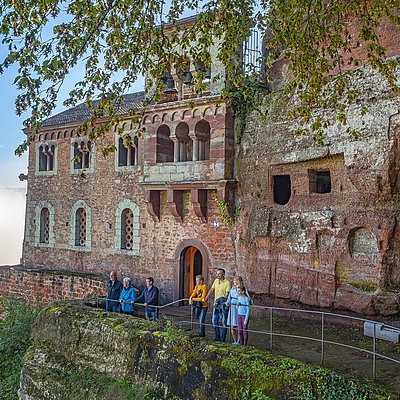
Burial chapel in the Klause National Monument
Kastel-Staadt
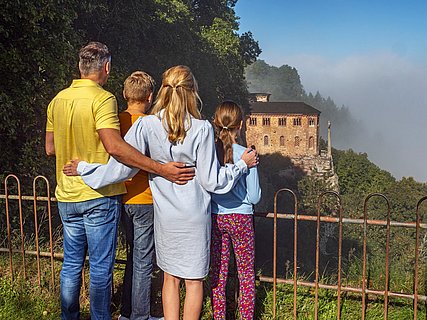
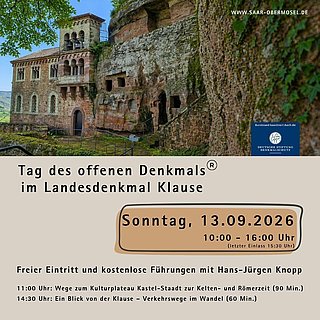
High above the Saar, at the tip of a protruding sandstone cliff, lies the hermitage of Kastel-Staadt. The sandstone plateau on which the hermitage is located has been used as a place of worship since the time of the Celts and Romans. In the early 17th century, a Franciscan monk built a chapel into the rock. The Prussian Crown Prince Friedrich Wilhelm, later King Friedrich Wilhelm IV, had the long-abandoned ruin converted after 1833 into a mausoleum for the blind Bohemian King John. The famous architect Karl Friedrich Schinkel designed the structure in a Southern European romantic style, with arched windows, columned arcades, and a bell gable reminiscent of Italian models. The bones of the Bohemian king rested in the hermitage from 1838 until they were transferred to the cathedral in Luxembourg in 1946. Overall, the hermitage is regarded as a highlight of German romanticism.
3D model of the hermitage
Information about the Saar-Obermosel holiday region can be found at www.saar-obermosel.de
Downloads
Burial chapel in the Klause National Monument
König-Johann-Straße
54441 Kastel-Staadt
0049 6581 995980
info@saar-obermosel.de
http://www.saar-obermosel.de
Business hours
Opening hours 2026:
April 1 - October 31, 2026: Wednesday to Sunday 10 a.m. - 4 p.m., July and August 10 a.m. - 5 p.m. Last entry is 30 minutes before closing. We are open on public holidays in Rhineland-Palatinate. Please note that the cloister may be closed at short notice due to weather conditions for your own safety.
Admission:
€5.00 adults, €4.00 students over 16 years, students, apprentices, retirees, the unemployed, severely disabled – each with proof, €2.00 children and teenagers aged 7-16 years, free for children up to 6 years


Das könnte Sie auch interessieren